
Roofing for School Districts in Davenport, IA
Roof condition reports, repair and replacement for school districts in the Davenport, IA area, written for board packets, bid scopes and summer windows.
The board packet is due Thursday, and the facilities director still has no number for the gym roof. There is a stain photo from March, a patch invoice from last fall and a maintenance note that says watch it.
For a school district around Davenport, IA, the roof is a budget line before it is a construction job. Someone has to explain it to a board in plain terms, in a form that can be voted on. We start there. We walk the buildings with you, write a one-page summary of each roof, and lay out the options so your packet answers the question the board will ask: what happens if we wait one more year?
The Roof Summary for the Board
A board does not need a membrane lecture. It needs a clear picture: what the roof is, what is wrong, what the options are and what each one means for the school year.
Each building gets a short summary:
- Photos of the worst spots and the best, so the contrast is visible.
- The cause of any leak, in one sentence.
- Three options: repair, recover or replace, with the reason each does or does not fit.
- A rating that places the roof in the district's list of buildings.
These sit inside a written roof condition report, so the same facts serve the board, the architect and the insurer.
Districts That Reach Across Several Towns
School districts rarely sit in one place. Blue Grass students attend the Davenport Community School District, with Davenport West High School serving the area, and Buffalo students attend Buffalo Elementary and then Davenport West too. North Scott Community School District keeps its administrative offices in Eldridge. Camanche, Durant and Orion each run their own district, and the Riverdale district serves Cordova.
A district that draws students from towns like Blue Grass, or runs its offices in Eldridge, means more driving, more keys and more ways for a roof to fall off the list. We keep one schedule and one set of photos across the sites, so the building on the edge of the district gets the same look as the one beside the central office.
Storm Claims on Public Buildings
Hail is part of the record here: 2 inch hail was reported on April 7, 2020, and the count of hail reports within 10 miles of the city center stands at 133 since 2004. The EF-2 tornado of July 11, 2025 began southeast of Blue Grass and then cut a seven-mile path across Davenport. After a storm like that, a district may be filing on several buildings at once.
The first need is a record. A dated, photographed inspection of each roof shows what the storm changed and what was already there. We walk the roofs with the insurer's adjuster when asked, and the photos, the locations and the repair scope go into one claim file so the board sees the same facts the insurer does.
Code, Insulation and the Re-Roof Trigger
Davenport works from the 2021 IBC and IEBC with local changes, and it also lists the state energy code. A re-roof that opens the assembly can bring insulation requirements with it. A district that plans on a plain membrane swap and then learns about added insulation will see the budget move.
So we check the code before we write the scope. The deck, the insulation and the cover board are looked at together, because the right answer for a gym is not the right answer for a classroom wing. Your general contractor or construction manager sees the same numbers we do, early.
Warranty Papers and the Handoff
Superintendents change. Facilities directors retire. A roof warranty can outlast three of them. When the paperwork lives in someone's desk, the district may not know what it holds until a leak shows up and a claim has to be filed.
We build a file for each roof: the system installed, the manufacturer paperwork, the drain map, the repair log and the inspection photos. Keeping the inspections that coverage often requires on the calendar is the point of roof warranty management. The file also helps when a facilities lead hands a school building to a successor, and it gives public bodies the record their auditors expect.
District work is easiest to budget when each finding has a building, roof zone and school-calendar window attached. We flag items that need attention before occupancy, such as an active leak over classrooms or a blocked drain above a common area. Quieter survey work can happen when students are present if access is controlled, while tear-off and crane days usually need a break or a clearly isolated zone. The report gives facilities staff a prioritized list they can connect to summer work orders.
Send the Packet Date and the Building List
Send us the board meeting date and the list of buildings that worry you most. We will set the walkthroughs with your facilities lead and return roof summaries ready to drop into the packet.
Questions About School Districts
Our summer budget gets set in winter. How do we price a roof we have not opened up?
Write the scope with allowances for what you cannot see. We cut a few cores before the budget is set, so the layers, the deck and the insulation moisture are known. Then the estimate carries a stated allowance for deck repair and wet insulation, priced by the square foot of what is found. The board approves a number with a range around it, and any change after the tear-off is a quantity, not a surprise.
A hailstorm crossed the district. The insurer wants every roof inspected. Where do we start?
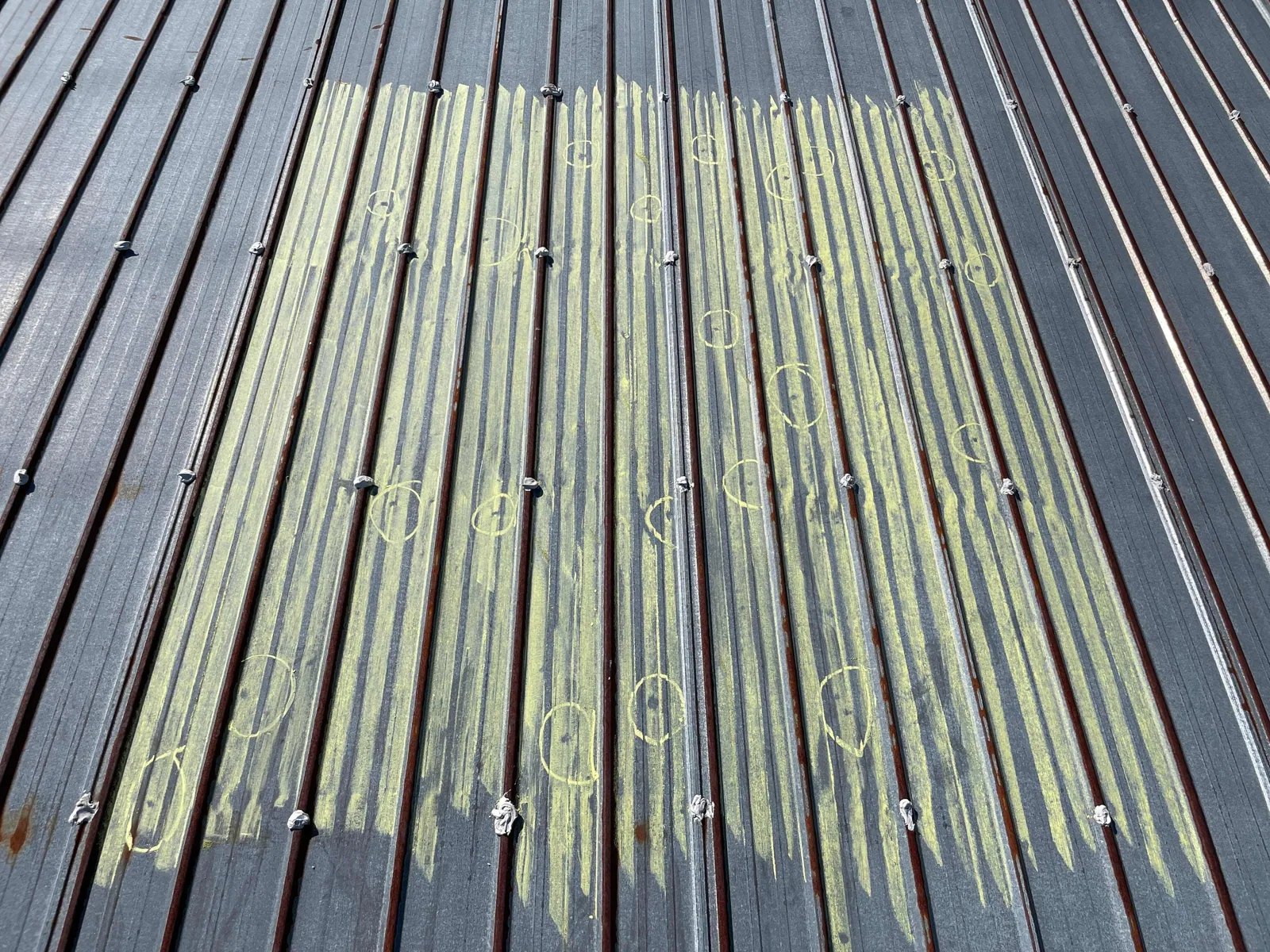
Start with the oldest roof and the one over the most occupied space. Hail leaves dents, bruising and broken granules or cracks, and those marks fade into the weather record fast. Photograph and map them while they are fresh. Give the adjuster a combined report, not twenty separate emails, and keep the district's own dated photos as the baseline.
The older high school has a metal roof that sheds snow onto the walkway. Do snow guards solve it?
They do for most cases, and they are cheap next to a slip injury. Guards hold the snow on the roof so it melts in place instead of sliding in a sheet. Placement matters: rows above the doors, spaced for the roof pitch and the panel profile. Check the gutter and the downspout at the same visit, since melt that cannot drain freezes at the edge and builds a ridge.
Can we replace a roof during winter break instead of summer?
For repairs, sometimes. Cold limits what adhesives, welding and cold-applied products can do, and daylight is short. A full replacement in December is usually a poor bet for the membrane and the schedule. If the roof cannot survive until summer, we make it safe for winter with a tight temporary repair and plan the full work for the first warm window.
We lost track of our warranty papers across a few administrations. Does that matter?
It matters, and it is fixable. Start with the building file, the architect's closeout set and any manufacturer correspondence. We can often tell the installed system from a core cut and the edge details, and the manufacturer can confirm the registration from that. Then we set up a single record going forward and put the inspection dates on a calendar the facilities office controls.
Our custodians clear the drains each fall. Is that enough between professional visits?
Drain clearing is the single most useful habit, so keep it. Add a ladder check after the first hard freeze and again after the spring thaw, and have staff photograph any standing water or lifted edges they see. Custodians should stay off the roof if it is wet or icy. Send us the photos, and we decide whether a visit is needed. Snow load and ice at the drains are what turn a small clog into a ceiling stain by February.


Talk to a Davenport Commercial Roofer
Send the work order, the building address or a few photos of what you are seeing. We will set a walkthrough, go up with whoever has the hatch key, and tell you plainly what the roof needs.