
Commercial Roofing in Blue Grass, IA
Commercial roof inspection, storm repair and replacement in Blue Grass, IA, with a plan for tornado, derecho, hail and winter damage across the Quad Cities.
The July 11, 2025 tornado began southeast of Blue Grass, and by the time it was done it had cut a seven-mile path across Davenport, IA, through Emeis Park and out to Kimberly Road and Fairmount Street. It was rated an EF-2, with estimated winds of 120 mph. For anyone who owns or manages a commercial building in Blue Grass, that date is a reason to go up on the roof and look.
We repair, restore, recover and replace low-slope and metal commercial roofs, and a storm check comes first after any tornado or derecho. The first sign is rarely a hole. It is a ceiling stain, a rattling noise, or a rooftop unit that seems to sit a little differently than it did last month. We go up, find out which it is, and write down what we see.
Why a Storm Path Needs a Roof Check
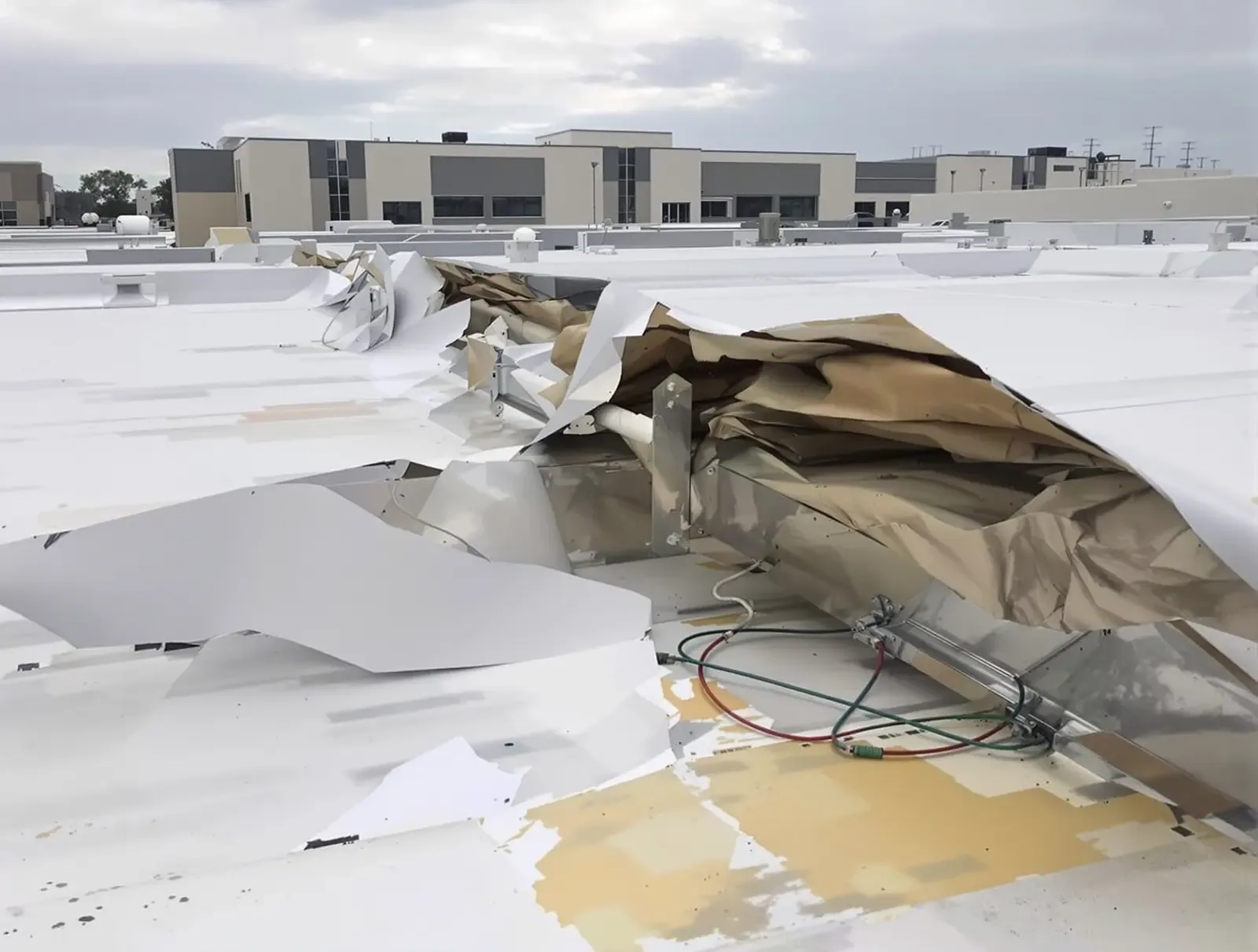
A tornado damages a narrow track. Buildings inside the track can lose membrane, edge metal or whole rooftop units. A building just outside may look untouched and still have taken a hard hit from flying debris, which punctures membrane in ways a ground inspection will not catch. Wind-driven debris leaves small cuts that let water in slowly, and the leak may not appear until the next heavy rain.
A 120 mph estimate puts real load on a roof. Uplift concentrates at corners and perimeters, where a low-slope roof is weakest. We look at those zones first: the coping, the edge flashing, the first few feet of field membrane back from the edge. Repair after tornado damage starts there, then moves to units, curbs and penetrations. A drone roof inspection can cover a large roof quickly and photograph spots a person on foot would miss, though it does not replace a hands-on walk where we suspect wet insulation.
Derechos Reach Further Than Tornadoes
A tornado hits a strip. A derecho hits the region. At Davenport Municipal Airport the August 2020 derecho registered an 86 mph gust, and the National Weather Service reported extensive roof damage in Davenport, Bettendorf and elsewhere in Scott County from damaging winds that lasted 30 to 60 minutes. In July 2024, another derecho carried winds up to 100 mph across the area, and 10 tornadoes touched down in the Quad Cities service area.
Thirty minutes of sustained wind does more than one gust. Fasteners work loose, seams peel back a little further with every pulse, and a patch that held through the first blast can fail in the second. When a roof has been through one of these events, we check the whole wind damage picture, not only the spot where the leak showed up. The leak is often the last symptom, not the first.
A Growing Town and Newer Paperwork
Blue Grass had 1,666 residents in 2020, a 14.7 percent gain over 2010. In a growing town buildings change hands and tenants come and go, and a roof that came with a manufacturer warranty may have conditions attached that the new owner never saw. Many warranties require reports, repairs by approved methods or a maintenance record. Ask for the paperwork before you need it.
A storm is the wrong time to find out what a warranty does and does not cover. If the roof is still under one, we want to read the terms before we touch anything, because a repair made the wrong way can complicate a claim. A roof warranty management file keeps that straight: what the document requires, what has been done, and what the roof needs next.
Storm Walk, Step by Step
The sequence stays the same after any wind event, and it goes in this order:
- Edges and corners, where uplift does the most work
- Drains and scuppers, which debris often blocks
- Rooftop units and curbs, for shifted bases and torn flashing
- Field membrane, for punctures, bruises and open seams
- Interior, for stains, wet insulation and damp deck
We photograph each finding and mark it on a roof plan. You get the photos the same day, along with a short recommendation. Some storm damage needs a temporary dry-in tonight and a permanent fix next month. For an active opening, emergency roof repair focuses on temporary protection first; the permanent fix follows once the weather and claim allow. The proper repair follows once the weather and the claim allow.
Paperwork After the Wind
Insurance claims run on documents. Dated photographs of the roof, a written description of what changed and a repair estimate separate from any work already done all help an adjuster see the same thing you do. Roof insurance claim assistance starts with that documentation: what we found, where, and what it takes to repair it.
Timing matters on both sides. Do not wait for a leak before reporting storm damage, since your policy may carry a deadline. At the same time, do not let temporary repairs wait for a claim decision. Standing water and open seams do more damage each day. We make temporary repairs that protect the building, record them, and keep the receipt for the file.
Repair, Recover or Start Over
Storm damage can mean a small repair, a large section or a full replacement. A localized puncture or edge failure gets a repair. A roof with widespread damage to the membrane or wet insulation across a large area usually points to replacement. In between, a recover over a sound existing system can be an option if the deck and insulation allow it.
Roof size, the number of penetrations and the extent of wet material move the price. Weather moves the calendar. After a major storm in the region, crews and materials can be in short supply, so we tell owners early what lead times look like. The 2025 tornado ran as far as Kimberly Road in Davenport, so the same steps apply along the Kimberly Road corridor.
Send the Photos and Set a Walkthrough
Send the address, the storm photos you have and the date the leak first appeared. We will set a walkthrough around your tenants and your schedule, then come back with photos and a plain recommendation.
Questions About Blue Grass
The tornado did not touch our building, but a neighbor lost shingles. Should we still have the roof looked at?
Yes, if you are within debris range or felt strong wind. Flying debris can nick a membrane or loosen edge metal without leaving anything you can see from the ground. We would check the perimeter, the units and the drains, and send photos so you have a record whether we find something or not.
Our rooftop air handler seems to sit crooked since the last storm. Is that a roofing problem or an HVAC one?
Both, and it needs both trades. A shifted unit can tear the flashing at its curb and open a path for water. We inspect the curb and seal, and your HVAC contractor checks the unit itself. Do not run a unit that has moved on its curb until someone has looked, since vibration can widen any gap.
A patch from the 2024 derecho is still in place. Do we need to redo it?
Not automatically. We would pull back any sealant, check what the patch is stuck to and test the area around it. Many patches are fine, but the ones to worry about sit on a loose edge or an aged membrane. If the patch passes, we tell you and move on. If it does not, we explain what is failing and why.
Does our roof need a thermal scan after a storm?
Only if the walk raises a doubt. An infrared survey shows wet insulation that a dry surface hides, and it is worth the cost when a leak has appeared or when the storm was severe. For a roof with no signs of water entry, photos and a hands-on check are usually enough.
Which storm photos should we take before anyone touches the roof?
Take wide shots of each side of the building, then close-ups of any damage with something for scale. Add interior photos of stains. Date everything. Send them with the work order and we will line them up against what we find on the walk.



Talk to a Davenport Commercial Roofer
Send the work order, the building address or a few photos of what you are seeing. We will set a walkthrough, go up with whoever has the hatch key, and tell you plainly what the roof needs.