
Roofing for Manufacturers in Davenport, IA
Roof repair, recover and replacement for manufacturers in Davenport, IA, scheduled around production, second shift, process exhaust and shutdown weeks.
Second shift finds water on the floor by the press line. The lead radios the plant manager, who radios maintenance, who looks up and sees a stain on the deck. By the time anyone says the word roof, a cart of finished parts has been moved twice.
That is how plant roof problems tend to surface in Davenport, IA: through production, not through the roof. No industry in the Quad Cities employs more people than manufacturing, close to 30,000 of them, and many of those buildings run long hours. We plan roof work around the line, not the other way around. A walkthrough with the plant manager comes first, then a schedule, then the work.
Production Schedule First
Before we price anything, we ask four questions. When is the slowest stretch of the year? Which lines can stop and which cannot? Where do trucks and forklifts cross under the roof edge? Who signs off on the safety talk?
The answers set the job. A plant with a planned shutdown week can take a full tear-off in that window if materials are staged ahead. A plant with no shutdown does the work in sections, with a crew finishing and drying in each section before the next one opens. On a manufacturing plant roof the sequence runs the same way: schedule, access, staging, then membrane.
Process Exhaust and Membrane Choice
Exhaust stacks put grease, oil mist, steam and chemical vapor on the roof. Some membranes tolerate that and some do not. A membrane that sits in a plume of hot, oily exhaust can swell, harden or lose its welds near the fan.
So the question is not just what the roof is made of. It is what lands on it. A PVC roof holds up better near grease and many chemical exposures than most single-plies. Where a fan discharges onto the field, we add a walk pad or a splash shield, or move the discharge point. We look at the exhaust map with your maintenance lead before a membrane is chosen.
Foundries, Mills and River Humidity
Metal plants have their own problems. The Joint Manufacturing and Technology Center on Rock Island Arsenal runs a foundry and large manufacturing halls. Deere's Davenport Works builds large equipment such as articulated dump trucks. Arconic's aluminum rolling mill in Riverdale employs about 2,000 people. Any plant that adds process moisture to Mississippi River humidity puts water vapor in the air, and that vapor finds the underside of the roof deck.
Condensation looks like a leak and is not one. We tell the difference with a moisture scan and a check of vents and insulation, because fixing a roof that was never leaking does nothing for the stain. The Eastern Iowa Industrial Center holds a Kraft Heinz plant of 382,157 square feet, and Amazon's fulfillment center sits in the same park as a logistics neighbor. In any plant, rule out interior moisture before anyone blames the membrane.
Hot Work, Cranes and Lockout
Plants run permits, and we work inside them. Hot work needs a permit and a fire watch. Roof-mounted equipment needs lockout. A crane pick needs a lane that does not cross a loading dock or the line below.
We submit the plan ahead:
- Hot work: cold-applied or mechanically fastened options where we can, with a fire watch where we cannot.
- Lifts: scheduled in quiet hours, with the swing path cleared.
- Fall protection: guardrails or controlled access zones at open edges and skylights.
- Debris: contained on the roof, never over a door or a walkway.
Plants with an overhead bridge crane add one more review, since crane loads and roof loads both end up in the building frame.
Snow, Ice and the Derecho Record
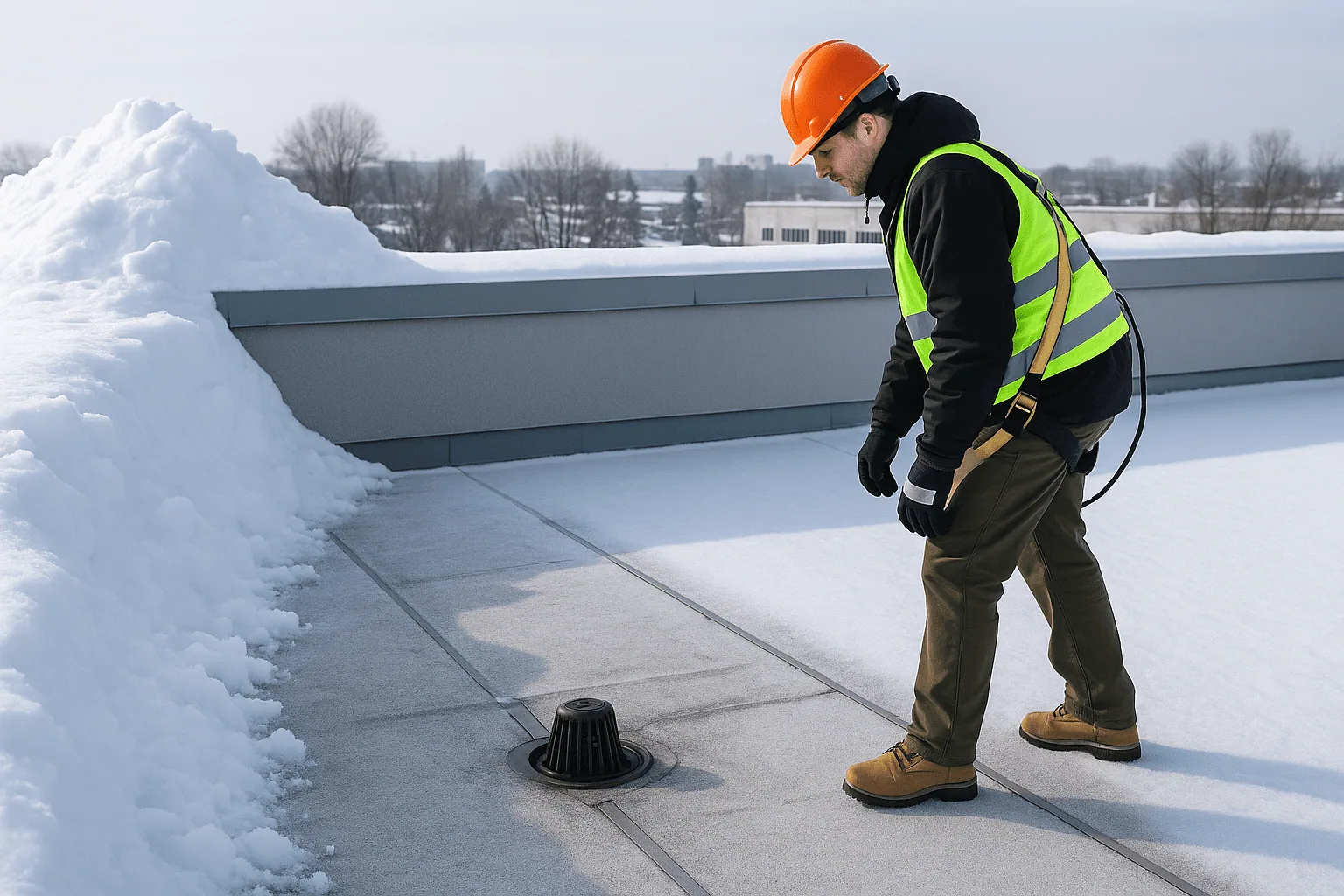
Quad Cities snowfall averages over 36 inches a year. A tall bay beside a low bay collects drifts, and when the drift melts the water finds the flashing between them. Ice at a roof drain does the same. Snow and ice damage in a plant usually starts at those two spots.
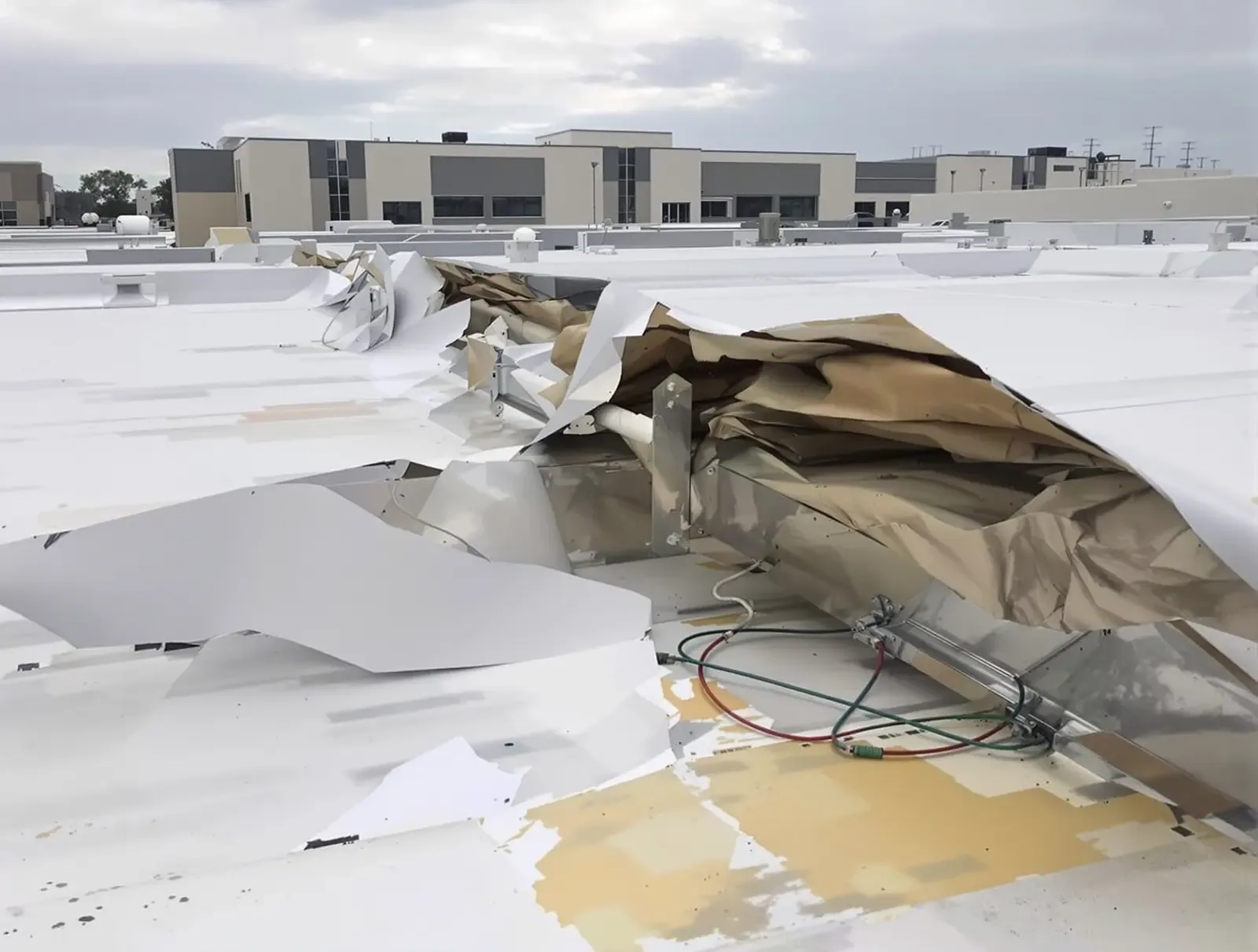
Then there is wind. The August 2020 derecho was the costliest thunderstorm disaster in U.S. history, and a July 2024 derecho carried gusts to 100 mph. Plant roofs are large, and wind works at the edges and corners first. We check perimeter metal and corner fasteners, and wind damage repair starts there when a storm has been through. When a plant expansion is underway, we coordinate with your general contractor so new tie-ins do not undo old flashing.
Production facilities often have roof areas with different consequences and access rules. A leak over a packaging line, an electrical room or a raw-material bay may require different containment and timing even when the roof defect looks similar. We mark the affected process area, check what can safely remain in service, and schedule the repair around shutdown or sanitation windows supplied by plant operations. The closeout records any temporary protection and the inspection point that must be revisited after production resumes.
Send the Work Order, Name the Window
Send the work order or a photo of the stain, and tell us which weeks are quietest. We will arrange a walkthrough with your plant manager and return a schedule the production side can live with.
Questions About Manufacturers
Our shutdown week is fixed and cannot move. Can a roof scope fit inside it?
Fit the scope to the week by choosing what is truly needed. A repair or a single section of replacement can often run inside a week if material is on site early and the weather window holds. A whole-building tear-off rarely fits, so we propose phases across several shutdowns and keep the roof dried in at each stop. Send us the calendar and the building plan, and we will tell you in the first walkthrough what fits.
Exhaust from a process line is wearing out the membrane near one fan. How do we stop it from coming back?
Look at the plume before the membrane. Move or extend the discharge so it clears the roof, or add a splash shield and walk pad under it. Then replace the damaged area with a membrane that tolerates what comes out of that fan. Ask for the chemistry on the exhaust from your maintenance lead. If it contains grease or solvents, say so, because that changes the product we choose.
Our maintenance crew patches leaks with whatever is on the shelf. Is that a problem?
It becomes one when patches stack up. Mixed materials do not bond, and a patch on a wet roof traps the water it was meant to keep out. Keep your crew's quick fixes for emergencies, log where each one goes, and let us review the log on a routine visit. We replace patches that failed and leave the ones that are sound. A maintenance plan with a simple log saves more than any one repair.
The adjuster calls our lifted edge metal normal wear after the derecho. What shows otherwise?
Photographs with dates and direction. Wind damage follows a pattern: windward corners and edges, creased sheets, fasteners pulled in one direction. Wear looks scattered and gradual. We document both, mark the damage on a roof plan and compare it with any earlier inspection photos you have. A report that ties the damage to a storm date holds up better than a conversation about it.
Can a roof job run while the bridge crane is working underneath?
Usually, with limits. Work above the crane bay goes in stages with a hold on crane travel while heavy loads move overhead. The deck and the crane runway steel are both checked before any equipment lands on the roof. We coordinate the schedule with your crane operators and the plant manager, and keep the crew off the section above a live pick.
Talk to a Davenport Commercial Roofer
Send the work order, the building address or a few photos of what you are seeing. We will set a walkthrough, go up with whoever has the hatch key, and tell you plainly what the roof needs.