
PVC Roofing in Davenport, IA
PVC single-ply roofing for Davenport, IA food plants, hospitals and kitchens: grease resistance, welded seams, winter handling and repair of weathered sheet.
The exhaust fan at the north end of the kitchen drips a brown film onto the membrane. Maintenance wipes it up every few weeks. Nobody has asked what it is doing to the roof.
PVC is the single-ply sheet people reach for once that question gets asked. It is a white thermoplastic membrane with hot-air welded seams, formulated to stand up to the fats, oils and many of the chemicals that soften other membranes. For an owner in Davenport, IA with a food plant, a clinic, a lab or a restaurant under the roof, it deserves a close look. It is not the right sheet for every flat roof.
Fats, Oils and Fumes
Grease is slow. It lands on the sheet at the discharge point, spreads with every rain, and works into the surface for years. A membrane that cannot resist it swells, softens and starts to lose seam strength right where the film is thickest.
Davenport has a food plant of that kind: Kraft Heinz built a meat processing plant in the Eastern Iowa Industrial Center to replace an older Oscar Mayer operation. Whatever roof a food plant carries, the discharge question has to be answered before anyone picks a sheet. Kitchens, labs and some metal-working plants raise the same question. PVC is formulated to hold up in those spots, which is why it is often specified near exhaust.
Even then, we add a grease catch or a walk pad under a fan that drips. A resistant sheet lasts longer when the fan stops painting it.
What Is in the Sheet
A PVC membrane runs a polyester or glass-fiber scrim between layers of plasticized PVC. The plasticizer keeps it supple. Over many years some of it migrates out, the surface stiffens, and the sheet becomes less forgiving of foot traffic and cold. Better formulations hold it longer, so a membrane is judged by its manufacturer's details and not only its thickness.
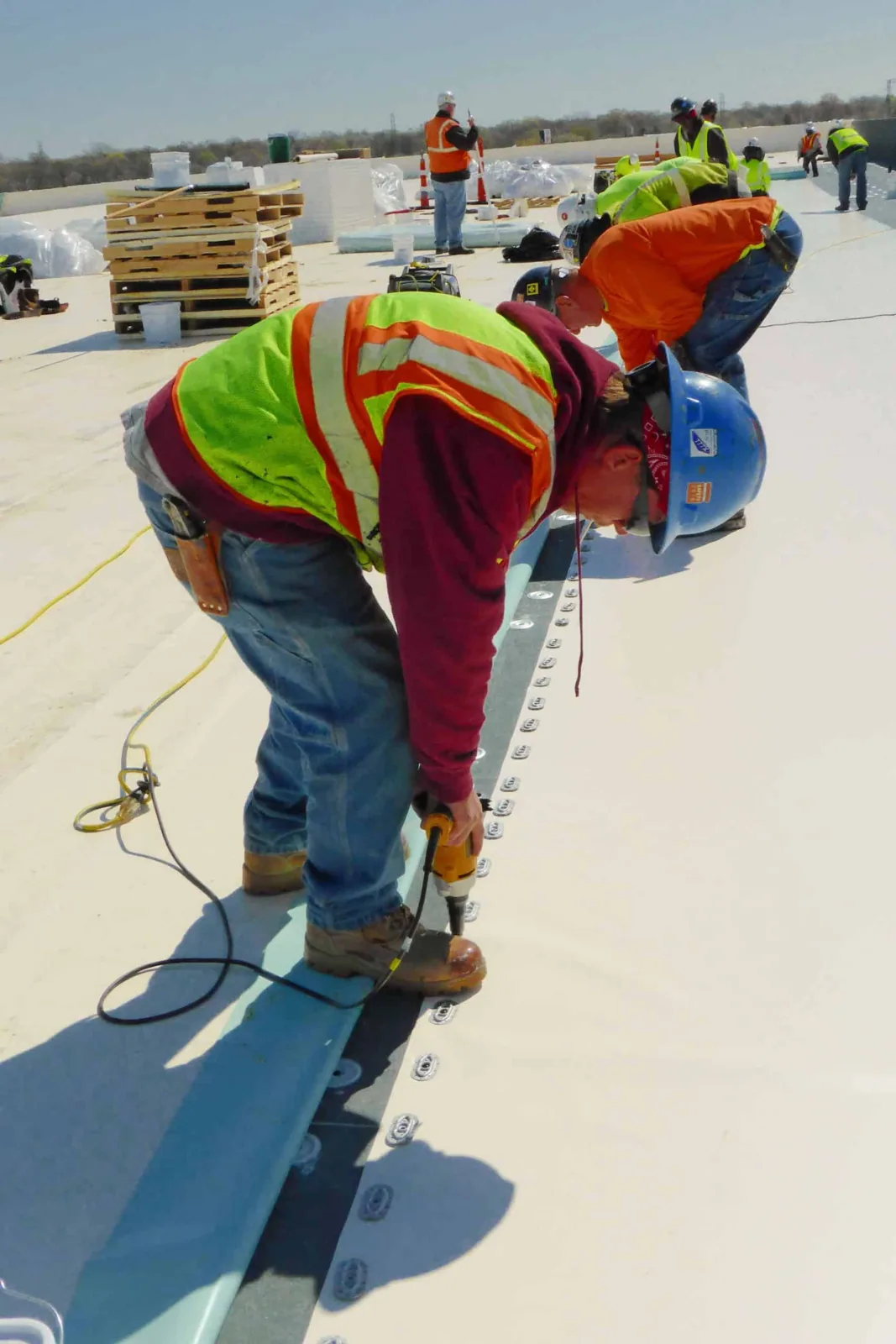
Seams are hot-air welded into one sheet, the same idea as TPO. Corners and pipe boots often come as pre-formed pieces, which means fewer hand-cut details at curbs. Some systems arrive as panels cut to the roof's measurements before they reach the site, such as those from Duro-Last, and others are rolled out and welded in place, as with Sika Sarnafil sheet. Which route suits the building depends on how many penetrations the roof has and how fast the deck has to be closed.
PVC Through a Quad Cities Winter
A normal Quad Cities year drops over 36 inches of snow, January heaviest at about ten inches, and Davenport records reach down to -29 F. PVC stays flexible in that cold once it is in service. It is the install that gets tricky.
Rolls stiffen when they are cold, so we stage them indoors or under cover and unroll only what the crew can weld that day. Hot-air welds need clean, dry sheet, and frost or a damp morning means we wait. In service, the bigger winter risk is the snow crew. A shovel or a rake that digs into a white membrane leaves a cut you will not see until it thaws, so we mark drains, curbs and walk paths and ask the removal crew to leave a layer on the roof.
Ice at a drain is the usual leak starter. We keep drain bowls and sumps clear before the first hard freeze.
Hospitals, Clinics and Occupied Floors
Genesis Health System is headquartered in Davenport and keeps patients in beds across five towns, DeWitt, Silvis, Aledo and Maquoketa among them. UnityPoint Health-Trinity adds to the stock. A roof over patients has a different set of rules.
Hot-air welding uses no open flame and no hot asphalt kettle, which is a real advantage over some other systems near a hospital roof. Welding does give off a mild odor, so before the first day we get the air intake locations from facilities, shield or relocate the ones we can reach, and build the schedule around surgery and imaging hours. The same planning helps a restaurant under a PVC roof, where the kitchen hood is both the reason for the sheet and the busiest time of day.
Tenant notice goes out ahead of noisy work, and the crew keeps to the access route the facilities team approves.
Repairing Weathered PVC
Old PVC does not always weld on the first try. Dirt, grease and lost plasticizer can keep a patch from bonding, and a weld that looks sound can peel the next week.
So we clean the area, then make a small test weld and pull it. If it holds, the repair proceeds. If it tears away clean, we know the sheet has aged past easy repair, and we tell you before anyone buys materials. Isolated punctures and open seams are routine. Widespread brittleness is not, and a roof like that is better replaced than patched at every visit.
If water is already inside, a leak repair call comes first to dry it in. The sheet question can wait for the walkthrough.
PVC, TPO or Something Tougher
PVC costs more than TPO in most bids, and the extra buys chemical resistance and a longer record in tough spots. On a plain warehouse roof with no exhaust, that is often money not needed. Where exhaust, fuel, solvents or cooking oils reach the roof, it often pays for itself.
When the exposure is heavier still, a PVC alloy such as KEE membrane is the next step up. The Eastern Iowa Industrial Center is mostly large manufacturing and warehouse buildings, and any plant there with heavy exhaust is a candidate for that conversation.
Send the Exhaust Layout
Send the roof plan with the exhaust points marked, or a photo of the staining around the fan. We will set a walkthrough, look at what is landing on the sheet and tell you whether PVC fits the building.
Questions About PVC Roofing
We have a grease stain around the exhaust fan on our current roof. Do we replace the membrane or just clean it?
Clean it first, then judge. Degrease the area with a cleaner the membrane maker approves, rinse well and see whether the surface firms up again. If the sheet stays soft, tacky or swollen, the damage has gone through and that area needs to be cut out. We also add a grease catch under the fan so the problem does not come back.
Is PVC worth the added cost over TPO on a plain warehouse roof?
Usually not, unless the building will change use. A dry warehouse with a few rooftop units has little for PVC to resist, and the money is better spent on insulation, drains or a thicker sheet. If a tenant might bring in food prep or a process line later, ask for PVC now and save a reroof down the road.
What separates PVC from KEE, and when does the difference matter?
KEE is a PVC-based blend with an added modifier that holds the plasticizer in the sheet, so it stays flexible and resists oils for longer. The difference matters over exhaust that runs every day, near fuel, or where animal fats and solvents settle. On an ordinary roof the two behave much the same, and PVC is the simpler pick.
Can PVC be installed in January, or do we wait for spring?
It can be done on the right day. Cold narrows the window, because welds need dry, clean sheet and the rolls have to be warm enough to unroll flat. For a roof that is leaking now, we stop the water with a temporary repair and schedule the permanent work for a stretch of workable days. For a planned reroof, spring through fall gives you the most room.
Will the welding smell reach the clinic or the offices below?
Welding gives off a mild odor, much less than hot asphalt, but an air intake can still draw it inside, which is why we plan for it. Tell us where the intakes are, we cover or shift them during the work, and we pick welding hours that avoid your most sensitive times. Facilities usually knows the schedule better than anyone.
Talk to a Davenport Commercial Roofer
Send the work order, the building address or a few photos of what you are seeing. We will set a walkthrough, go up with whoever has the hatch key, and tell you plainly what the roof needs.