
Roofing for Cities, Counties and Public Agencies in Davenport, IA
Roof assessments, bid-ready scopes, repair and replacement for cities, counties and public agencies in Davenport, IA, with records that stand up to audit.
The call comes Monday: a ceiling tile fell in the meeting room over the weekend, and the commission meets Thursday. The facilities supervisor has a roof report from two springs back and a capital list with the same building on it twice.
Public roofing in Davenport, IA runs on paper as much as on membrane. A city, county or agency has to describe the problem, show the options, take bids and keep a file that an auditor can read later. We write for that process. You get a walkthrough, photos, quantities and a plain recommendation, then a scope that can go out to bid without surprises hiding inside it.
A Scope That Survives the Bid
A weak scope draws weak bids. If the document says replace the roof and nothing else, every bidder guesses at the deck, the insulation and the drains, and the low number wins on its guesses.
We build the scope from what is actually on the roof:
- Core cuts and photos that show the layers, the deck and the moisture.
- Quantities by area, so bidders price the same roof.
- A stated allowance for wet insulation and deck repair, priced per unit.
- Details for drains, edges and penetrations, drawn instead of implied.
Our condition report becomes the basis of design, whether your engineer takes it forward or your staff does.
Buildings That Never Empty
The October 6, 2016 EF-1 tornado tracked from Credit Island over I-80 near Middle Road in Bettendorf, with 115 mph winds, and left damage on the roof of the Scott County Jail. A building like that does not close for repairs. People are inside around the clock, and the roof has to stay watertight while the work goes on.
The same holds for dispatch centers, courthouses and many other government buildings. We plan for escort, tool inventory and sign-in, keep material staging outside the secure line and phase the roof so one section is always dried in. Water coming through the ceiling of a secure area is a safety event, not just a repair, and the plan treats it that way.
Civic Buildings with Old Masonry
Downtown's historic district, listed on the National Register in 2020, spans 49 acres between 2nd and 5th Streets and counts 33 contributing buildings, the 1895 City Hall and the Scott County Courthouse among them. Work on buildings like those has its own review, and the roof is only part of the question.
Parapets, coping and built-in drainage take the load on older masonry. A repair that changes the line of a cornice or the color of a coping may draw a preservation comment. We photograph the existing condition, propose the least visible fix that works and flag early what needs review. The downtown core rewards patience at the start.
Airport Hangars and Armory Bays
Davenport Municipal Airport is city-owned, on 764 acres about seven miles north of downtown. It has a 7,460 square foot terminal with an attached 20,000 square foot hangar and a separate 12,000 square foot hangar. The August 2020 derecho produced an 86 mph gust there, the highest official reading in the immediate Quad Cities. Wind lift at the edges of a hangar roof is the first thing we check.
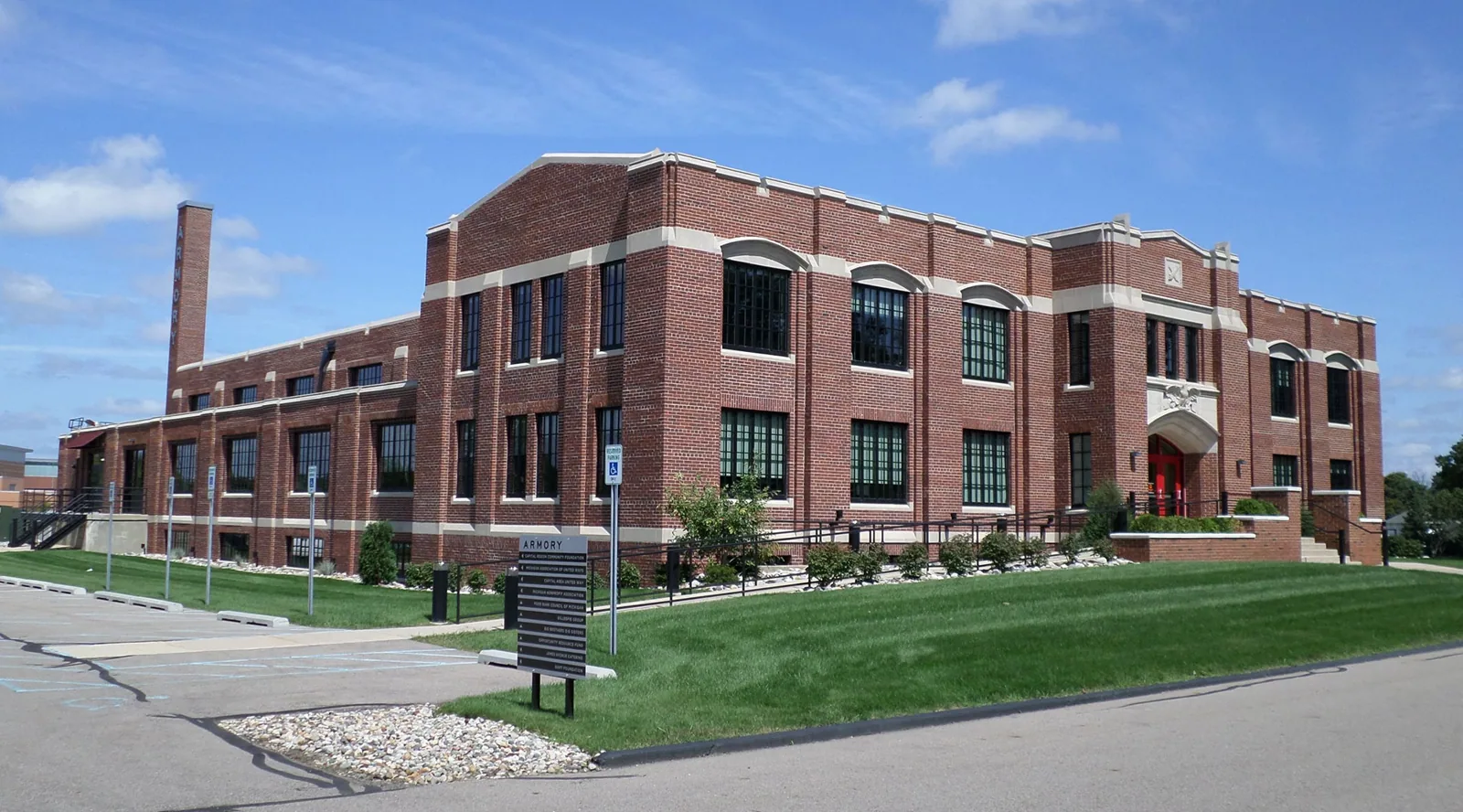
The airport also hosts an Iowa Army National Guard armory for the 1/109th Aviation Battalion. Across town, the 87,000 square foot Davenport Readiness Center on West Kimberly Road has a drill hall and vehicle work bays. For airport and armory work, access rules and operating schedules come first, and the roof follows them.
The File an Auditor Will Read
Public roofs outlive budgets and staff. Whoever opens the file in five years should find what was found, what was done and why. The city works from the 2021 IBC and IEBC with local amendments, and the file should say which edition governed the work.
Each job closes with a set of finished-work photos, a note on how the drains and edges look, the material data sheets and any warranty paperwork. Feed it into a roof capital plan and next year's budget request comes with evidence. A school district or a health system can build the same kind of file.
A public owner needs scope that can be compared and audited. We define the roof areas, quantities to be confirmed, access assumptions, protection measures and closeout records before work begins. When several buildings compete for the same capital allocation, condition ratings should explain the consequence of waiting, not just label a roof poor. Photos and marked plans give procurement and facilities staff a common reference through bid review, change requests and final acceptance.
Send the Work Order and the Bid Date
Send the work order, the building address and the date your scope has to be ready. We will set a walkthrough with your facilities lead and return photos, quantities and a recommendation that fits your process.
Questions About Cities, Counties and Public Agencies
Our bid documents are public. How much of the roof assessment belongs in them?
Put in everything a bidder needs to price the same roof: core cut results, photos, quantities, drain and edge details and the allowance structure. Leave out opinions about which contractor to pick. Public bidding works best when the scope is specific, because every bidder reads the same facts. We prepare the assessment so it can be attached as is, and we answer bidder questions in writing so every bidder gets the same answer.
A roof is leaking into a records room and the next bid cycle is months away. What is allowed?
Check your emergency purchasing provisions with counsel before spending, since rules differ by agency. On the roof side, we limit the work to stopping the water: a temporary repair, drain clearing and a tarp if needed, documented with photos and quantities. The permanent scope goes into the normal process. A tight temporary repair is easier to defend than a large emergency job.
Water is getting in at the parapet of an older masonry civic building. Can it be fixed without changing how it looks?
Often, yes. Most parapet leaks come from open mortar joints, cracked coping stone or failed flashing at the cap, and those can be addressed without altering the profile. Photograph the condition first. Then we choose a repair that matches the existing joint, color and line. If the building is in a historic district, bring in the preservation reviewer early and show them the photographs.
How does a crew get cleared to work on a facility that never closes?
Ask for the process in writing and send it to us early. Most secure facilities want a crew list, ID checks, a tool and material inventory and a named escort. Some also want hours limited to certain shifts. We submit the names in time, keep the crew small and check tools in and out at the gate. Delays usually come from late paperwork, so send the list as soon as the walkthrough is done.
Our fiscal year closes before we can finish the bid. Should the roof wait?
Not if it is leaking. Stabilize it now with a repair sized to last through the next season, and write the full scope for the next cycle. A stabilized roof lets the bid process run on its own clock. Have us log what was done, where and why, so the replacement scope starts from known conditions rather than guesses.
A council member asks how long a repair will last. What is an honest answer?
Give the range and the reason. A seam or flashing repair on a sound roof can serve for years, but a patch on wet insulation buys months. Say which one the roof is, and show the scan or core photo that supports it. Then name the next checkpoint, such as a spring walk after the freeze and thaw. Officials usually trust a stated condition and a date more than a promise.
Talk to a Davenport Commercial Roofer
Send the work order, the building address or a few photos of what you are seeing. We will set a walkthrough, go up with whoever has the hatch key, and tell you plainly what the roof needs.