
Commercial Roofing in Colona, IL
Commercial roof repair, drainage work, inspections and replacement for buildings in Colona, IL, planned around deliveries from the Big X interchange.
A property manager forwards a tenant email. Ceiling tile stained in the back corner, worse after Sunday's rain, and the question at the bottom is who has the roof hatch key. That is the whole work order, and it is enough to start from.
Colona, IL is a 3.92 square mile city in Henry County, with 5,045 residents, formed in 1997 when Green Rock and Colona merged. It sits along the Green River near the Rock River, and the eastern end of I-280, where I-80 and I-74 meet at the Big X interchange, is close by. For a commercial roof that location is mostly a matter of drainage and trucks: where water leaves the building, and how insulation, membrane and a lift reach it. We start with a walkthrough, and a commercial roof repair follows only when the walk says the roof needs one.
What the First Walk Covers
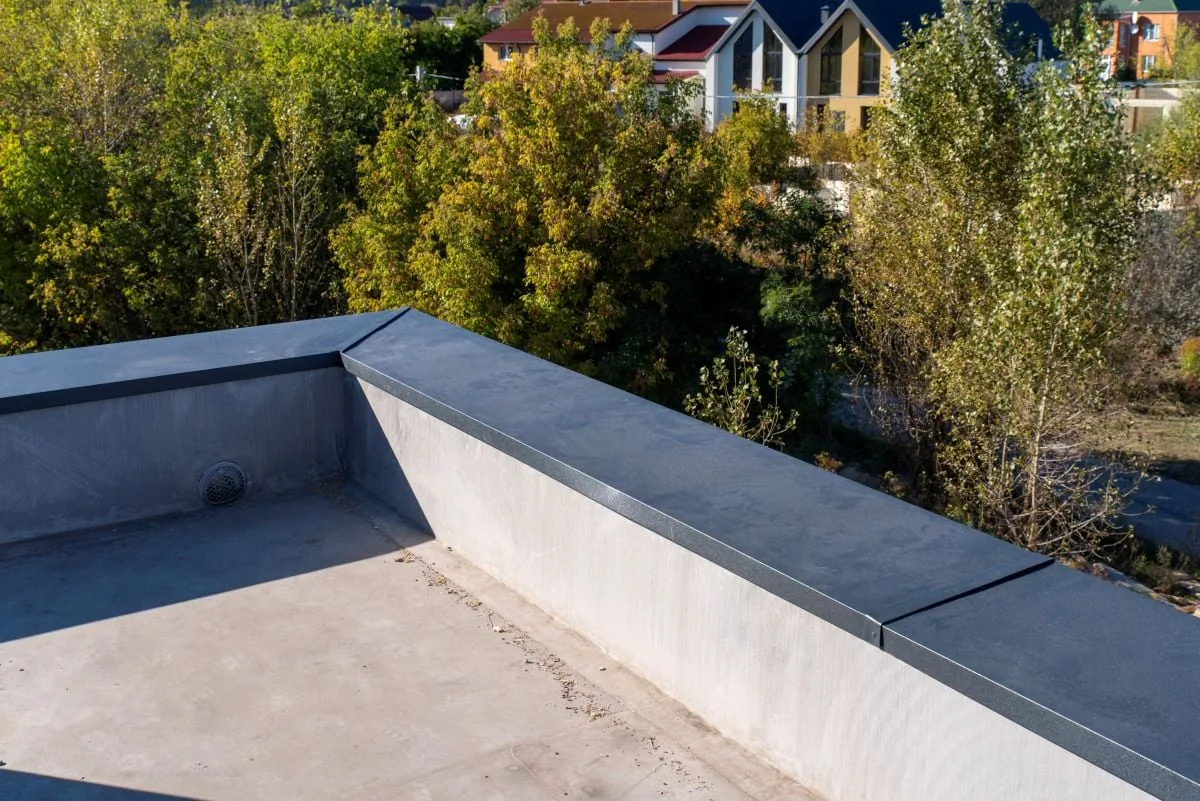
We go up the same way every time. First the roof hatch or the ladder, then a slow lap of the perimeter. Edge metal, coping, gutter joints and the first few feet of membrane inside the wall tell us how the roof has handled wind.
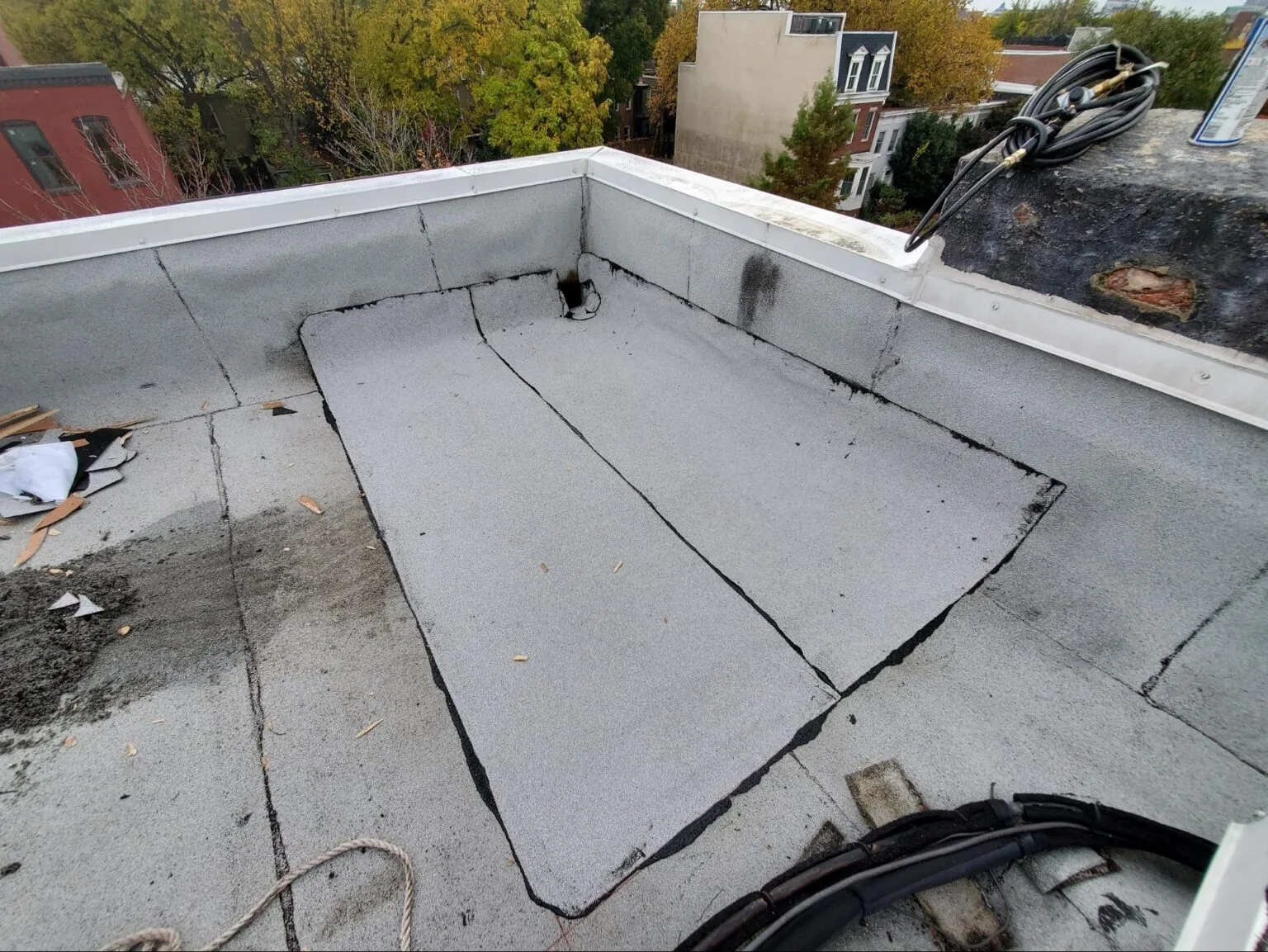
Then the field. We look for ponding, blisters, open seams, fasteners backing out and old repairs that have let go. Around every penetration we check the flashing: pipes, vents, rooftop unit curbs, skylights and any wall where the roof meets masonry or siding. These details leak long before a membrane does.
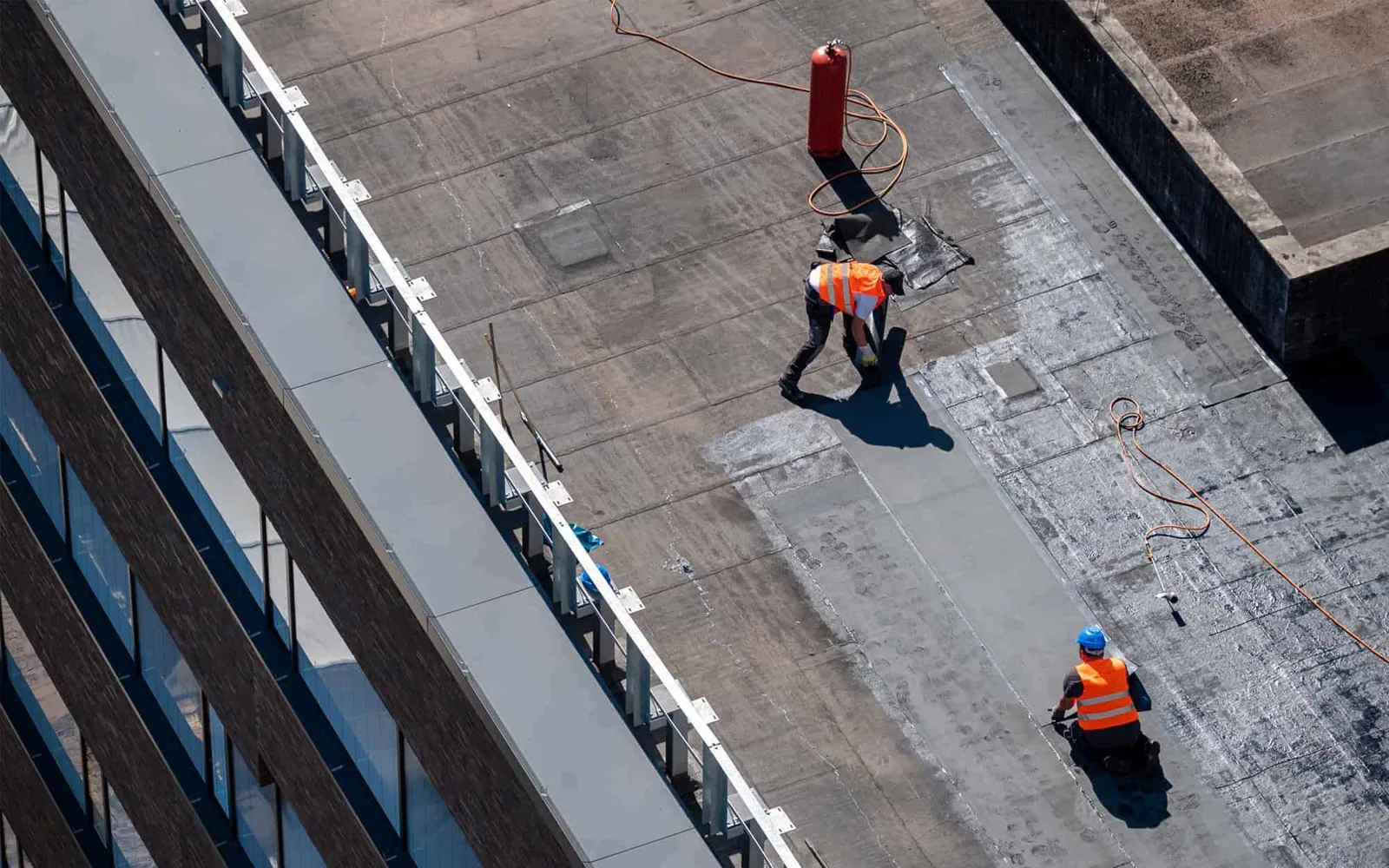
Last, the drains. We lift the strainer, clear what is in the bowl and check that the water leaves the roof. A stain below does not tell us where the water came in, so we trace it uphill. You get photos the same day and one of three answers: patch it, watch it, or plan the larger job.
Where the Roof Water Lands
Colona lies along the Green River near the Rock River, and a roof near rivers should not be judged without looking at the ground. Downspouts and scuppers send a lot of water to grade in a hard rain. If it lands on a low lot, a drive or a walk, the building pays for it later.
We trace the path from the roof to the ground. Do the downspouts discharge away from the wall? Is a scupper pouring across a walkway, and will that freeze? Is a gutter sagging because the fasteners have pulled out? Roof drain and scupper work is often the cheapest way to save a roof, because a drain that works takes load off every seam.
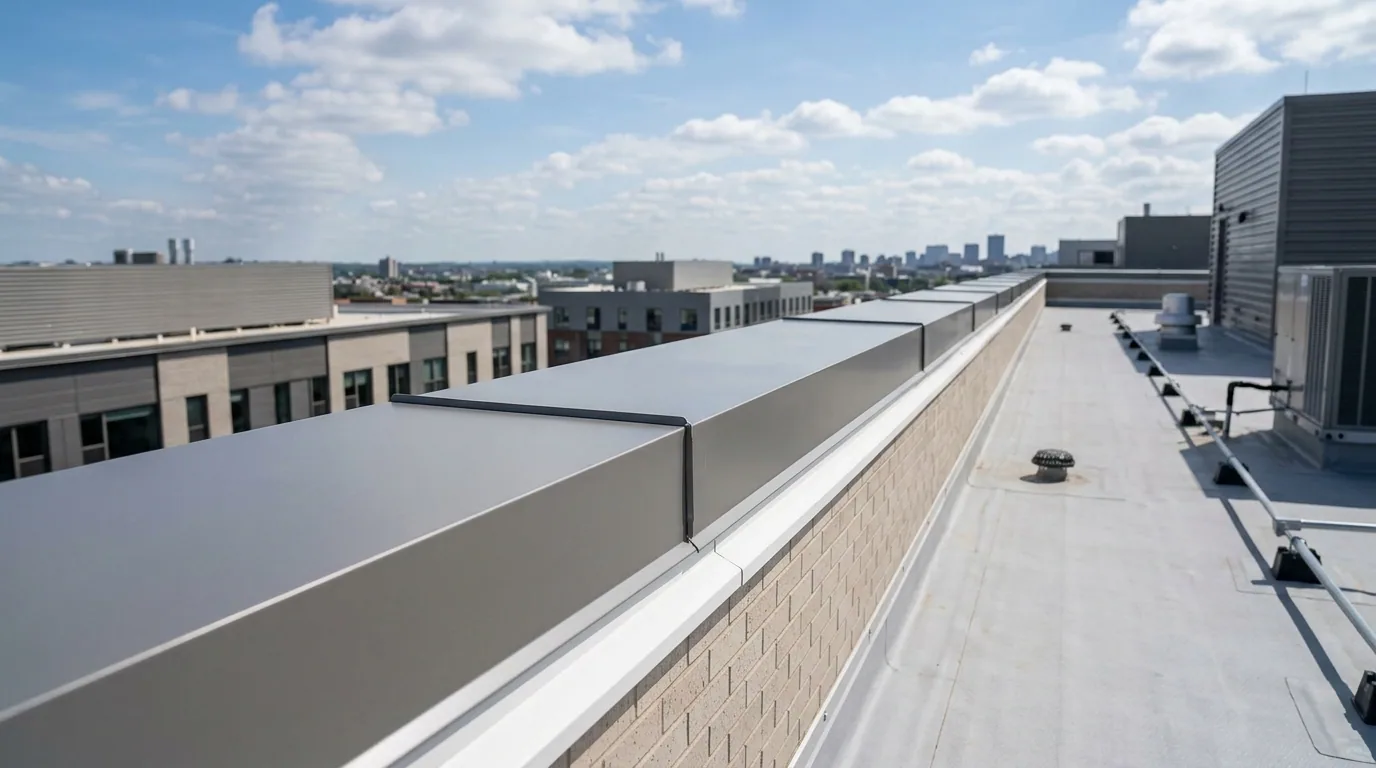
Edge details matter too. A loose gutter or open coping joint lets water behind the wall, where nobody sees it. Our edge metal, coping and gutter repairs close those paths before the freeze arrives.
Trucks From the Big X
A building close to a major interchange has an easy supply route. The Big X puts I-80, I-74 and the eastern end of I-280 within reach of the job, so material trucks do not wander. The hard part is the last stretch: a loading dock, a tight lot, a lane that cannot be blocked.
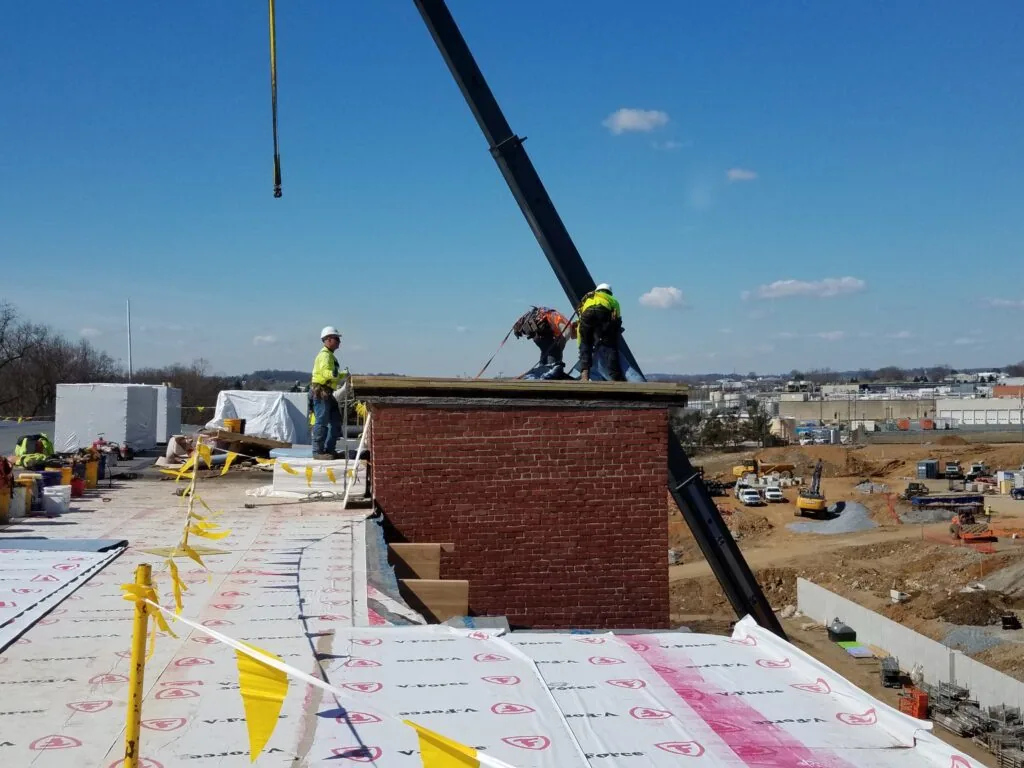
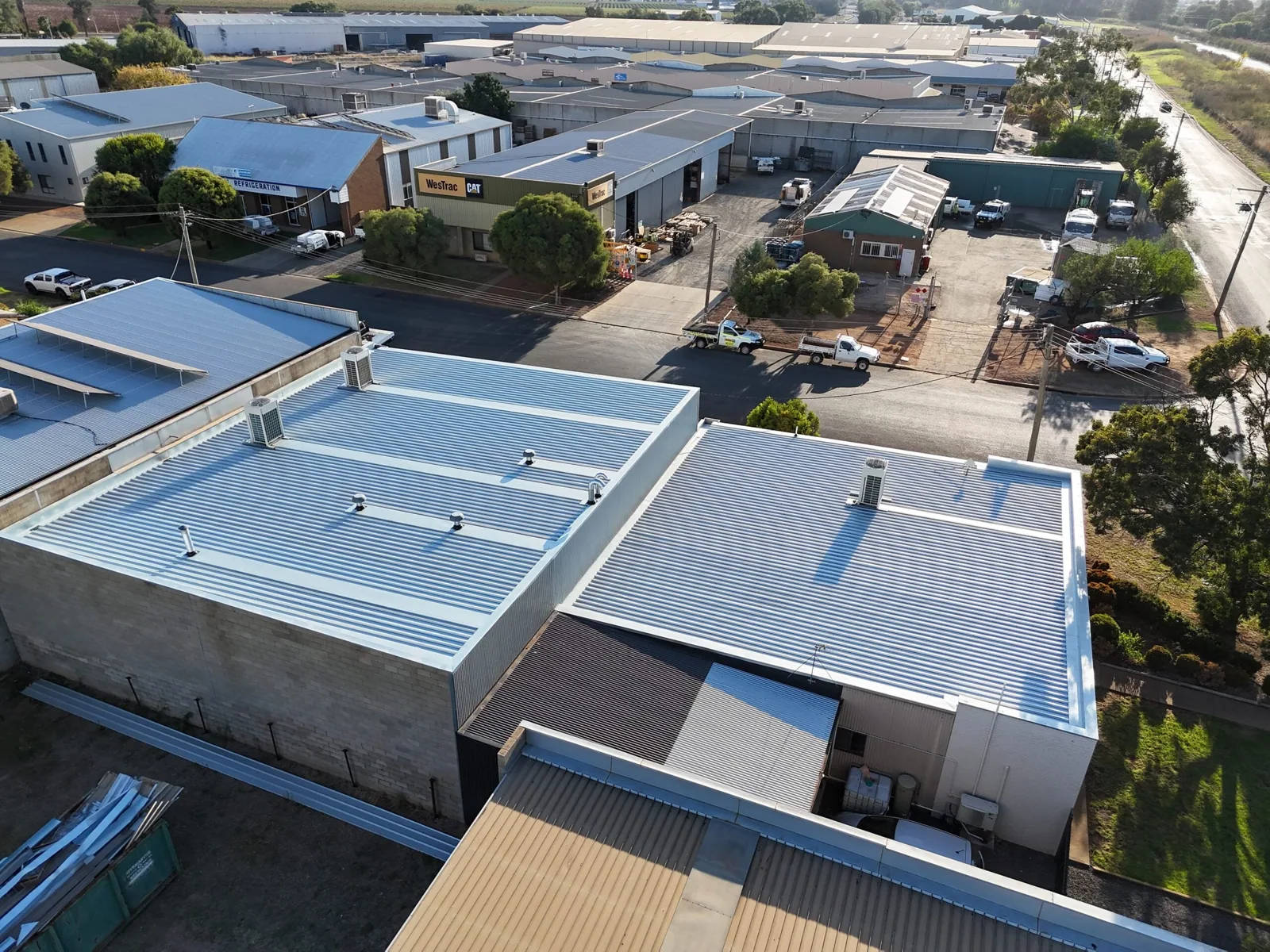
We lay out the delivery plan before the first truck. Where does the hoist stand? Which entrance is for the crew? Where does the dumpster sit, and does it block a fire lane? For a roof over active tenants, the answer to those questions is part of the contract. On an occupied building reroofing, the daily handoff tells the property manager what was torn off, what is dried in and what comes tomorrow.
Derecho Winds and Tornado Paths
A derecho on July 15, 2024 swept the region with damaging winds, and ten tornadoes touched down across the Quad Cities forecast area. The EF-2 tornado that crossed Davenport, IA on July 11, 2025 began southeast of Blue Grass, ran through Emeis Park and reached Kimberly Road, a path of seven miles with estimated winds of 120 mph. That path ended at the Kimberly Road corridor, a heavily developed commercial arterial.
The 2025 tornado crossed Davenport, not Colona. A building anywhere in the Quad Cities still faces the same season of storms. After any high wind we check the edges first, then the laps, then the attachment around rooftop units. Where we find a lifted flap, a flashing failure repair keeps the next gust from using it.
Snow Load and Spring Stains
Over 36 inches of snow falls in the Quad Cities in an average year, with January the heaviest month. Davenport has recorded highs of 111 F and lows of -29 F. The membrane shrinks hard in January and softens in July, and that cycle pulls on every seam.
Snow that drifts against a wall or a rooftop unit melts slowly, and the water finds the weakest detail. We check those spots after the first thaw. If you see a stain in March, do not wait for the next rain. The cause is often ice that formed over a drain or a gutter and sent meltwater back under the flashing. A preventive roof maintenance visit before winter clears the drains and checks the sealants, and it costs a fraction of the ceiling it protects.
Deciding Between Patch, Coat and Replace
The roof tells us which path fits. A patch makes sense when the failure is local and the insulation is dry. A coating makes sense when the membrane is sound but tired and the field is dry. When water has spread through the insulation, we recover or replace, and a moisture survey draws the limit of the wet area so the scope is not a guess.
The cost drivers are short. How much insulation is wet? What does the deck look like? How many openings and drains are in the field? Where can the hoist sit? The answers go into a written scope. The same written scope works for a building in Eldridge or Bettendorf as readily as one here.

Forward the Tenant Email
Forward us the tenant email or the work order, and tell us who holds the roof hatch key. We will set a walkthrough, take photos and give you a plain recommendation.
Questions About Colona
The stain is in the back corner, but the drain is on the other side. How do we find the real source?
We follow the slope and the seams, not the stain. Water travels along the deck and the insulation before it drips, so we start uphill and check every flashing and seam on the way. A moisture scan helps us confirm the path. We mark the source on a photo for your maintenance file.
A sagging gutter is pulling away from the wall. Should we wait until spring?
Do not wait. A pulled gutter lets water behind the wall, and ice will make the gap worse. We can reset or replace it before the freeze and secure the edge metal at the same visit. That usually ends the problem for much less than a repair of rotted trim.
How do we judge whether a coating is worth it on an older roof?
Check the insulation first. A moisture survey tells us whether the roof is dry. If it is, a coating can add years by sealing seams and reflecting heat. If the survey shows wet areas, we cut those out before coating, or we recommend a recover.
The tornado hit Davenport, not us. Is there any reason to inspect?
Yes, because storm winds and flying debris rarely check city limits. A quick walk costs very little and gives you a baseline photo set. If anything is lifted or punctured, you find it before the next rain does. If the roof is clean, the report goes in the file.
Can a crew work over occupied suites without shutting them down?
Usually, with a plan. We section the roof, protect the deck below, and agree on quiet hours with the property manager. A written tenant notice goes out first, listing doors, hours and noisy tasks. Anything that can be done off hours is scheduled that way.
Talk to a Davenport Commercial Roofer
Send the work order, the building address or a few photos of what you are seeing. We will set a walkthrough, go up with whoever has the hatch key, and tell you plainly what the roof needs.